Originally posted at: https://gannett.mynews360.com/news/760473/into-light-uses-portraiture-to-tell-stories-behind-lives-lost-to-overdose/
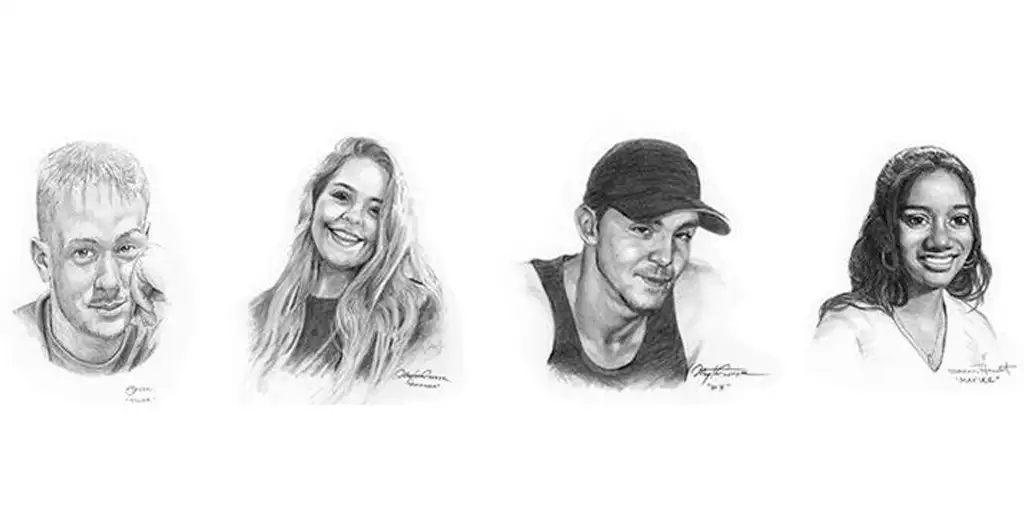
When Theresa Clower began drawing the portrait of her son Devon after his death in 2018, she wasn’t trying to start a movement. She was trying to find a way through grief; however, what began as one mother’s personal tribute has since grown into the INTO LIGHT Project, a national nonprofit that pairs graphite portraits with written narratives celebrating the lives of people lost to overdose and substance use disorder.
The project’s latest exhibition is on view at the Brattleboro Museum & Art Center through Nov. 1, bringing together portraits and stories of Vermonters whose families chose to share memories of their loved ones.
“Devon was 32 years old and died of an accidental overdose of fentanyl in February of 2018,” Clower said. “As a way of kind of giving myself time with that grief, I started portrait work. I had never really done a portrait in my life, but I did have a background in art. I hadn’t practiced much in about 50 years, so all of that was a bit of a mystery.”
INTO LIGHT’s exhibition asks visitors to spend time not only looking at faces, but reading the stories that accompany them. Together, the portraits and narratives emphasize the interests, relationships, personalities and accomplishments of the individuals represented, while acknowledging that substance use disorder ultimately became part of their lives.
For Clower, that distinction is central to the project’s mission.
“What started as a simple one-off exhibition in the city that Devon died, Baltimore, grew into a national organization now that even to this day I’m amazed,” she said. “What this just simply says to me is that there is a need for people to not only share grief — I mean that’s what the families do — but this is really about using those that we’ve lost to show the humanity in each one of them, and by doing that, we can break down that stigma, and that’s our mission.”
The INTO LIGHT Project has expanded steadily, partnering with museums, galleries and community organizations across the country. According to Clower, the organization expects to complete exhibitions in 30 states by the end of 2027 while continuing toward its long-term goal of presenting a unique exhibition in every state.
“I had no intention of starting a national organization,” Clower said. “But again, you know, the communities are where it is happening, and it continues. So, as of the end of 2027, we will have completed 30 exhibitions in 30 states. And our goal, in terms of numbers, is to get a unique exhibition in every state in the country, and then combine those. But really, that’s not our goal. Our goal is to educate. So these exhibitions are created. They’re beautiful.”
Each exhibition begins with families. Rather than asking participants to summarize a loved one’s struggles with addiction, the project invites them to tell the broader story of a person’s life. Families complete detailed questionnaires, submit photographs and share memories that become the foundation for both the written narrative and portrait.
“The submission is basically families submitting very, very detailed questionnaires that they fill out about their loved ones,” Clower said. “That’s turned over to a professional writer, someone who’s worked with us, and the same with the portraits. They submit three images, and those are turned over now to professional artists who render the graphite portraits, and then the writers, of course, write the narrative.”
The result is an exhibition that intentionally emphasizes people rather than diagnoses. “So the whole point of that again is to show humanity,” Clower said. “We don’t focus on the addiction. We don’t ignore it. We acknowledge it, but we focus on the whole person.”
For BMAC, hosting the exhibition reflects a broader philosophy about the role museums can play in community conversations.
“BMAC has a history of presenting exhibits that connect with social issues of particular concern to our community,” said Sarah Freeman, director of exhibitions at Brattleboro Museum & Art Center. “In 2018 we partnered with photographer Michael Poster and local organizations like Turning Point of Windham County, Groundworks Collaborative, and the Brattleboro Retreat to exhibit a series of portraits and personal histories of people in recovery from addiction, coupled with related programming.”
Freeman said the museum has also presented exhibitions addressing housing insecurity and gun violence. “We recognize that art has an important role to play in social commentary, and we are always interested in finding ways to connect with our community about issues that matter, and to provide a forum for discussion, using art and artists’ response to challenging social issues as a springboard.”
Hosting an exhibition centered on overdose loss also required careful planning. Museum staff considered not only how the artwork would be displayed but how visitors might experience it emotionally.
“The INTO LIGHT Project, our partner on this exhibit, has worked with many other organizations throughout the U.S. to present similar exhibits,” Freeman said. “They have given a lot of consideration to how the work and information are presented, including providing content warnings. At BMAC we thought a lot about how visitors would experience the space, and wanted to give room for people to sit and spend as much time as they needed in the exhibit, understanding that it will provoke strong emotions for some.”
The museum has incorporated seating into the gallery and encourages visitors to move through the exhibition at their own pace. Content advisories are also provided so guests understand the subject matter before entering the space.
Although INTO LIGHT addresses a difficult topic, Freeman said it represents only one part of BMAC’s broader exhibition program. “Because we have a variety of exhibition spaces and a schedule that allows for a certain amount of flexibility, we are able to balance exhibits that deal with heavier issues with those that offer art as a moment of reflection or respite.”
That balance, she said, allows the museum to present exhibitions that encourage discussion while continuing to offer visitors opportunities for inspiration, creativity and contemplation.
Brattleboro has long been home to organizations focused on recovery and substance use services, but Freeman believes the exhibition fills a different role.
“We are lucky in Brattleboro to have a strong community of people in recovery and organizations that do good work supporting those efforts, but stigma is still a big problem. I hope that the exhibit gives a space for the friends and families to grieve their losses and remember their loved ones, and I hope that visitors get to read the human stories behind the faces,” she said.
The museum plans to gather visitor surveys and encourage conversations with gallery staff to better understand how people experience the exhibition.
“We gather visitor surveys and our gallery monitors often engage in conversation with visitors so we are hoping to have a chance to hear how people feel about the show,” Freeman said.
For Clower, those conversations are ultimately what the project is designed to encourage.
The portraits cannot change the past, she said, but they can invite visitors to pause, look beyond the circumstances of a person’s death and consider the life that came before it. Whether visitors arrive with personal experience of substance use disorder or simply curiosity about the exhibition, INTO LIGHT asks them to see each portrait first as a human being — someone remembered by family, friends and a community that continues to carry their story.
Art and stories can be found at intolightproject.org for both the Vermont and New Hampshire exhibits.