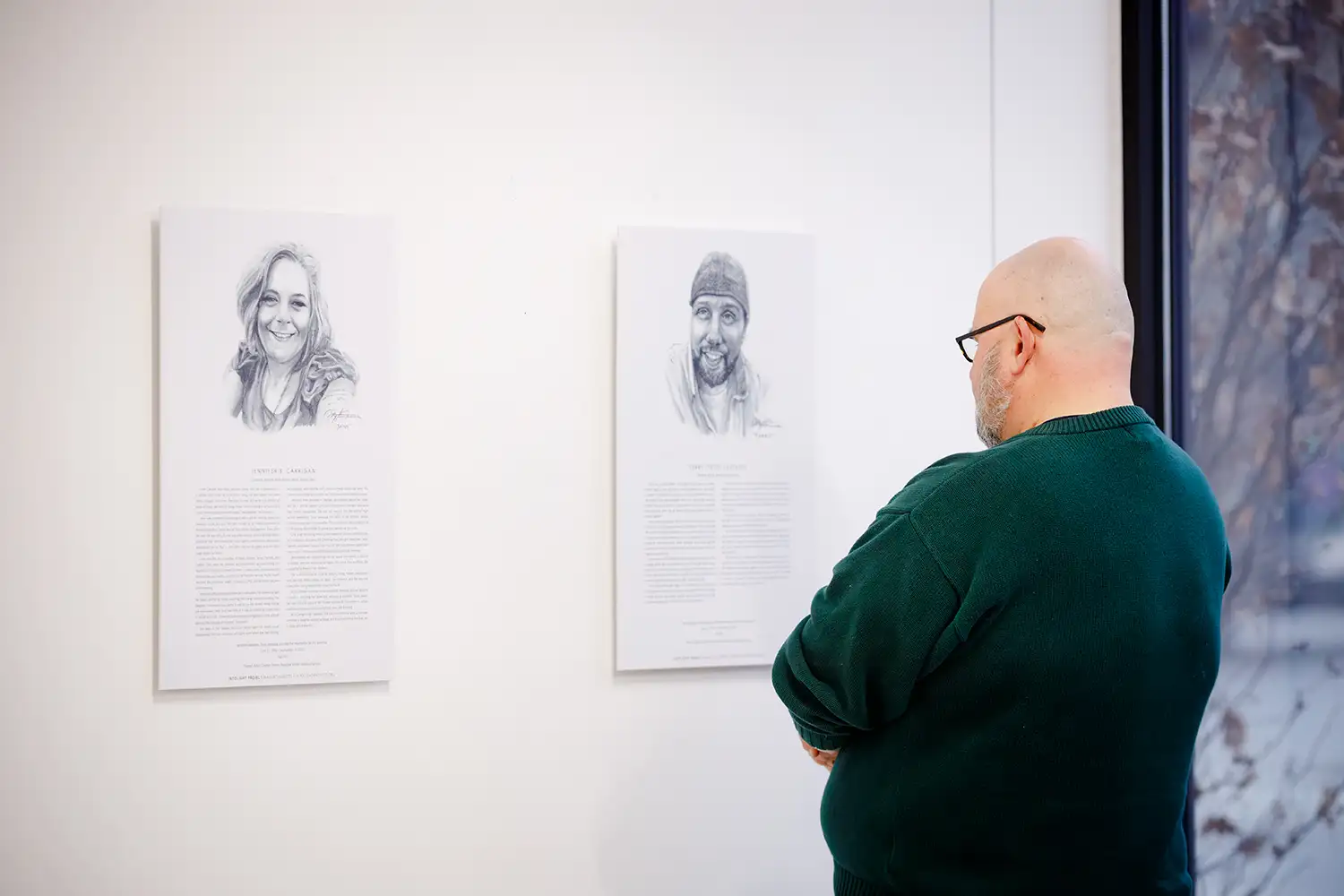
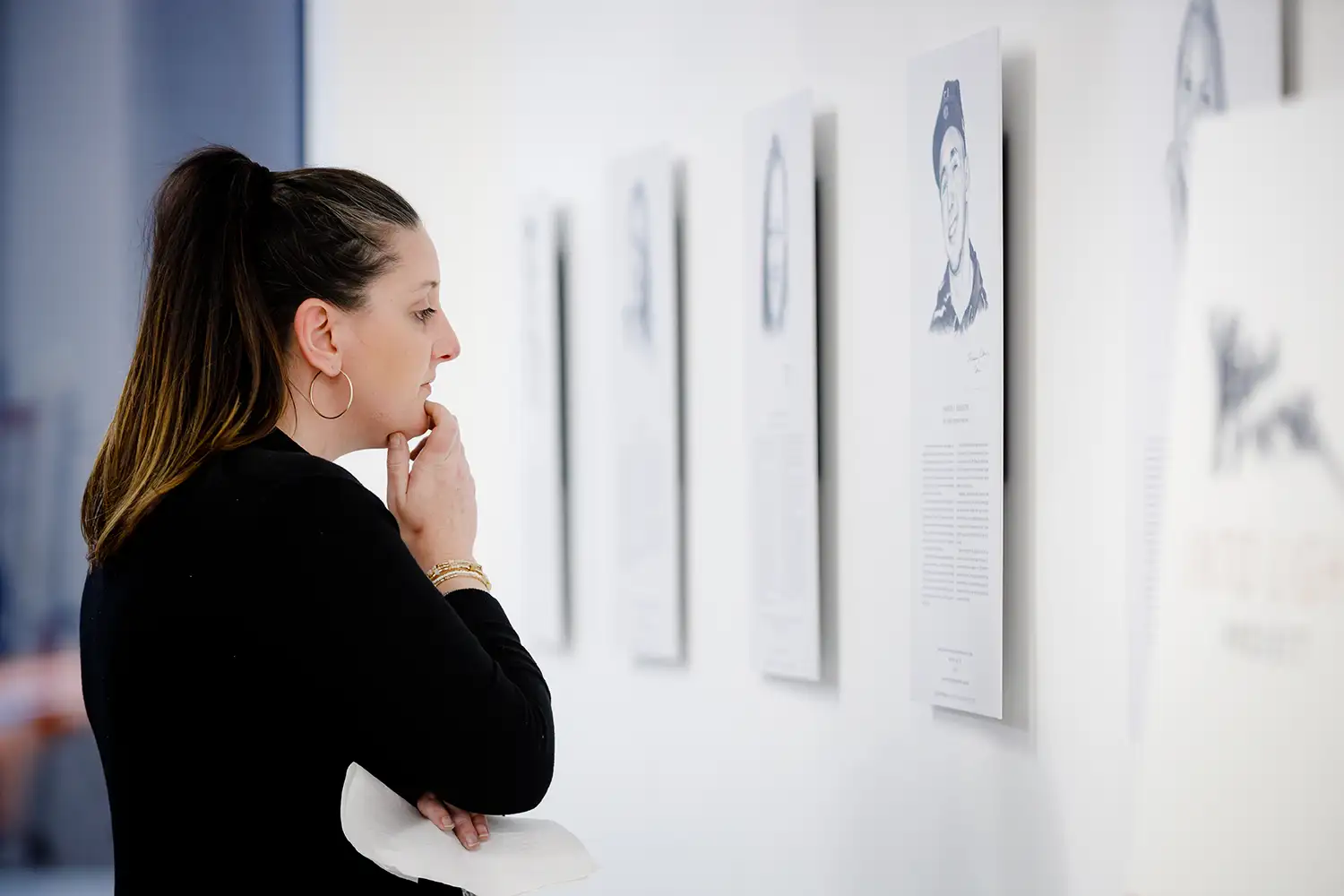
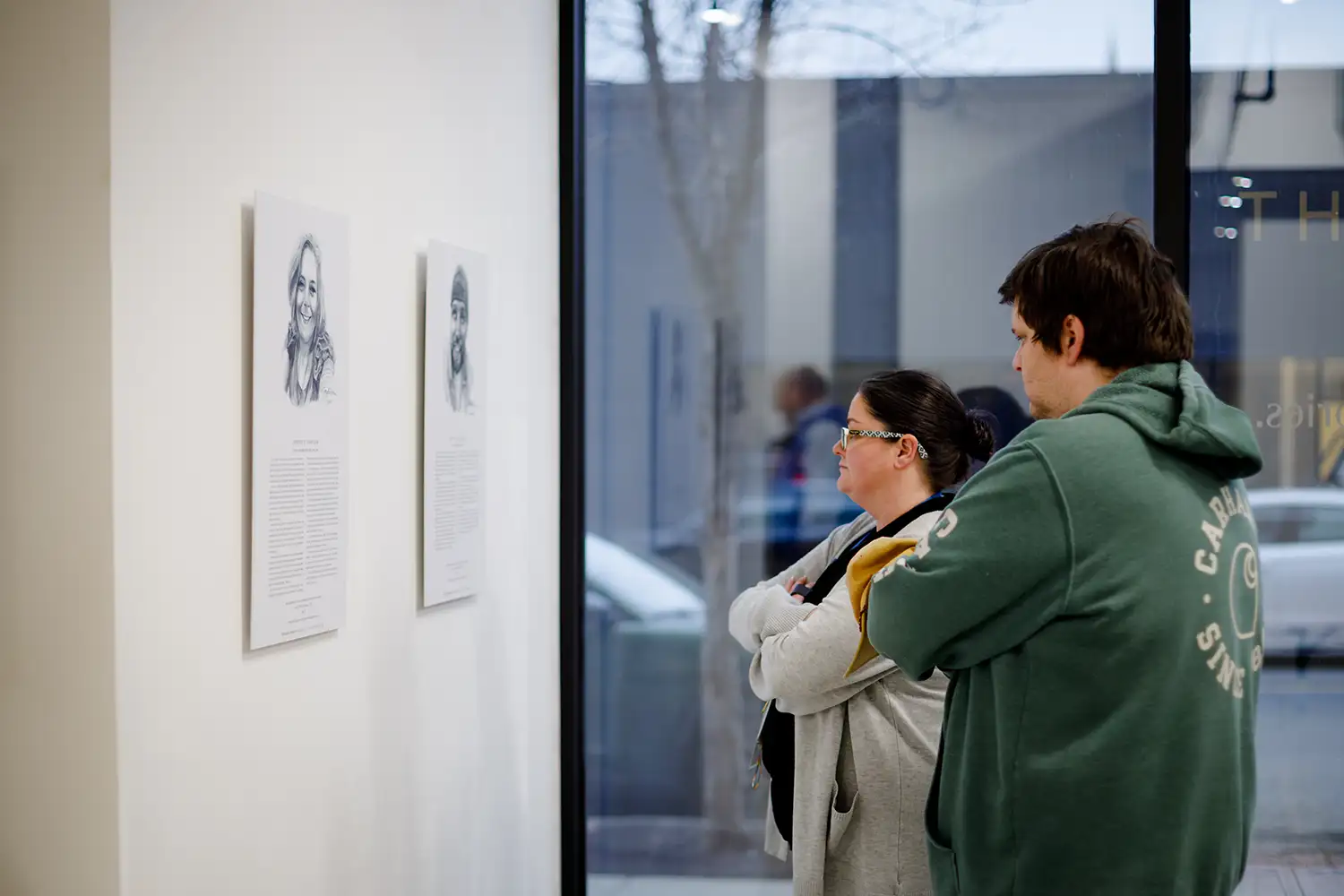
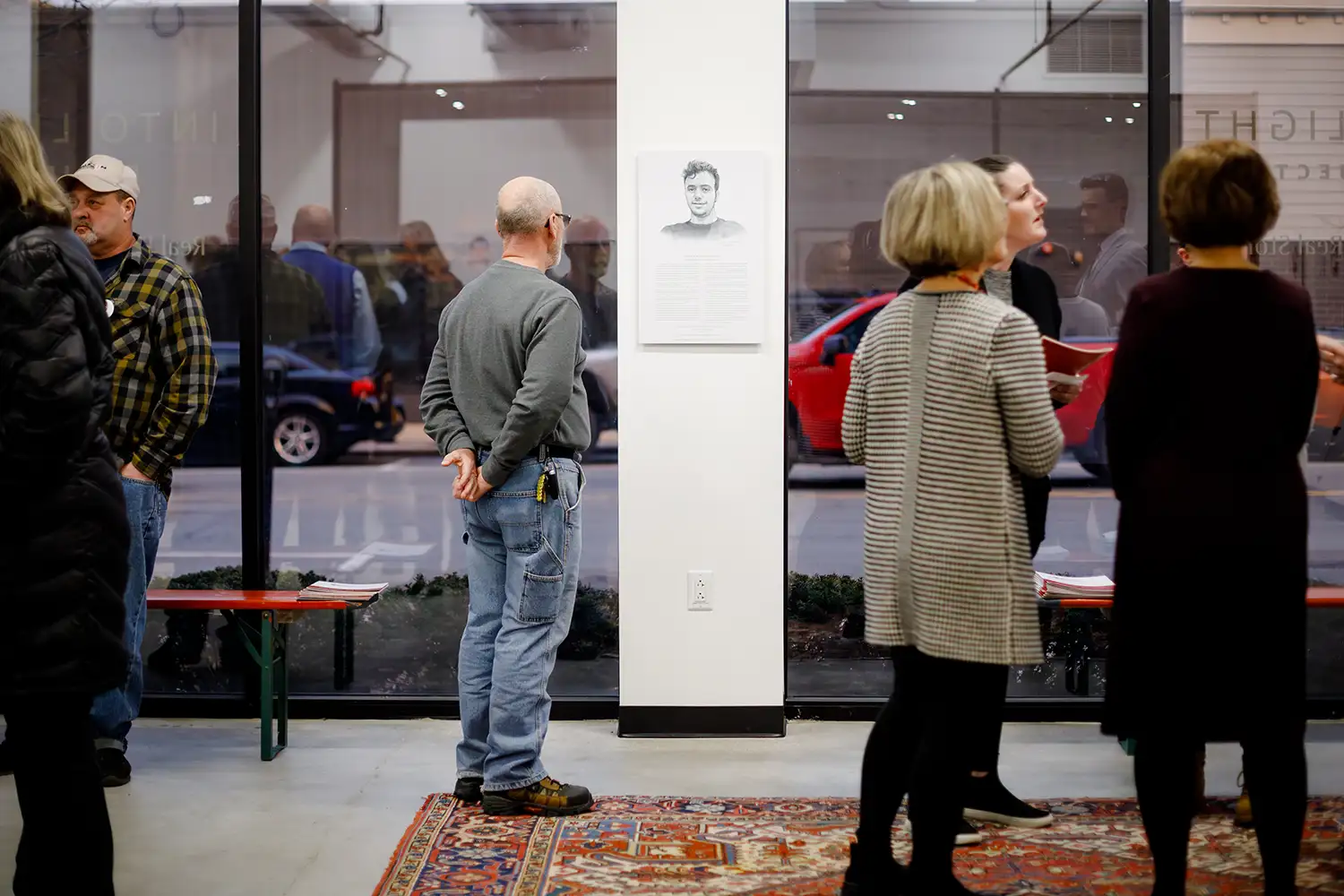
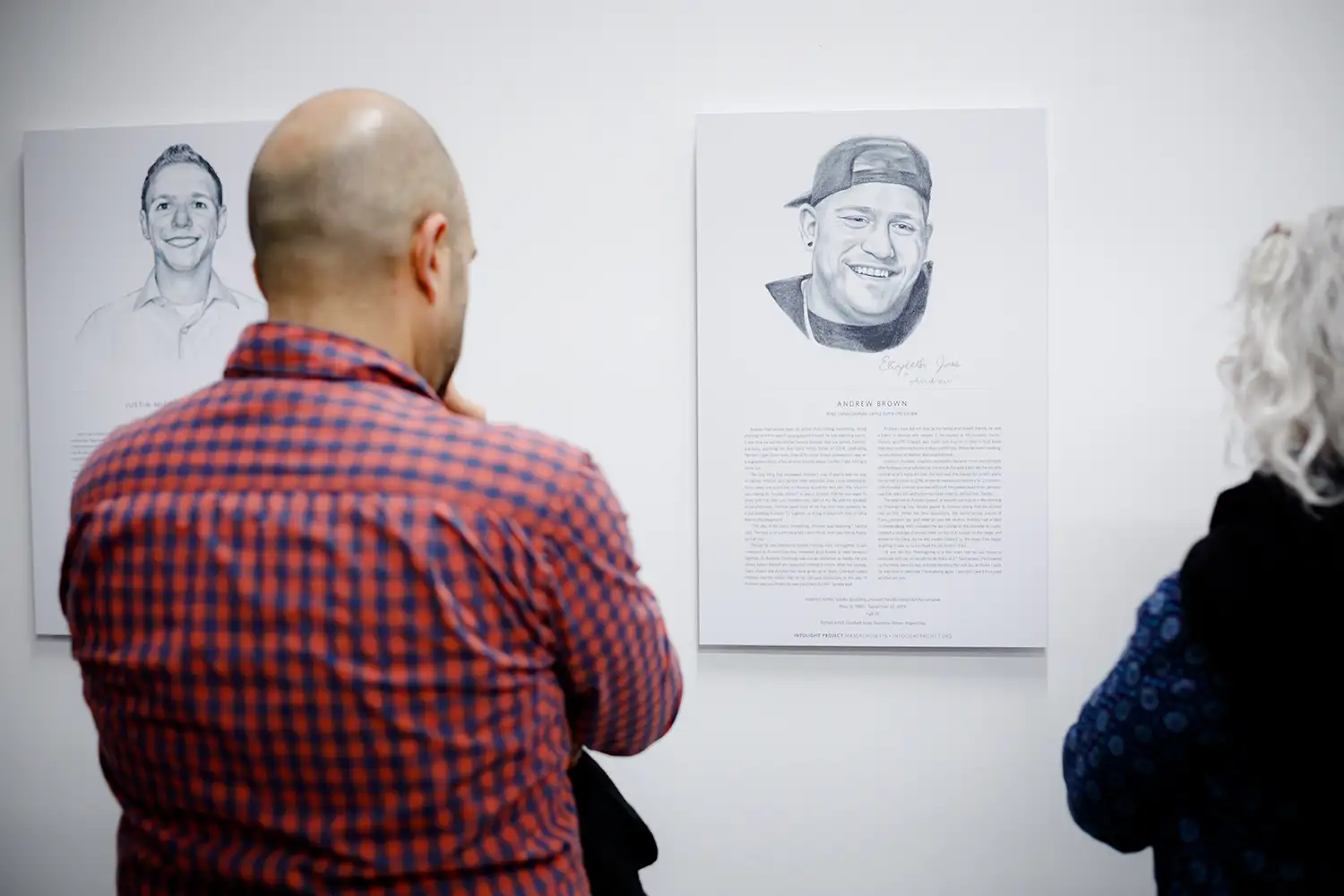
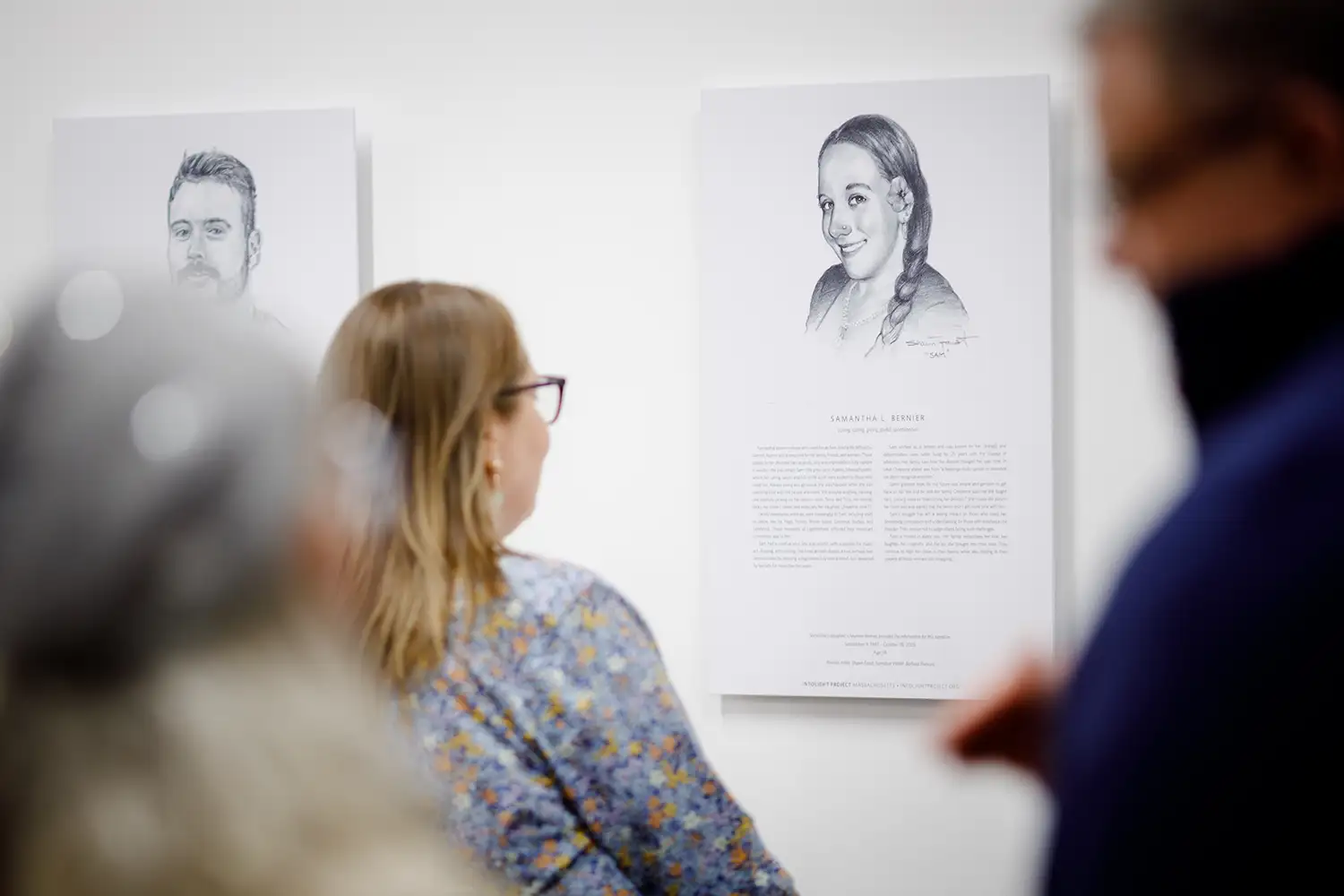
Every Drug Addiction: Real People, Real Stories exhibition begins with families. In each state, families share the faces and stories of loved ones who died from substance use disorder. The INTO LIGHT Project’s artists and writers then create an original graphite portrait and a written narrative for each person. Shown together, they humanize the disease of addiction and challenge the stigma that keeps so many people from seeking help.
When an exhibition closes, the original portraits are gifted to the families. But the need for the conversation doesn’t end there. Communities often ask how they can keep these stories in front of the people who most need to see them: students, health care providers, first responders, people in recovery, and families who still feel alone.
The Community Traveling Collection (CTC) is our answer. It is a high-quality traveling version of the exhibition that communities purchase and carry across their state, into the places where conversations about addiction matter most. The people in the exhibition deserve to be seen far longer, and far wider, than one season in one gallery.
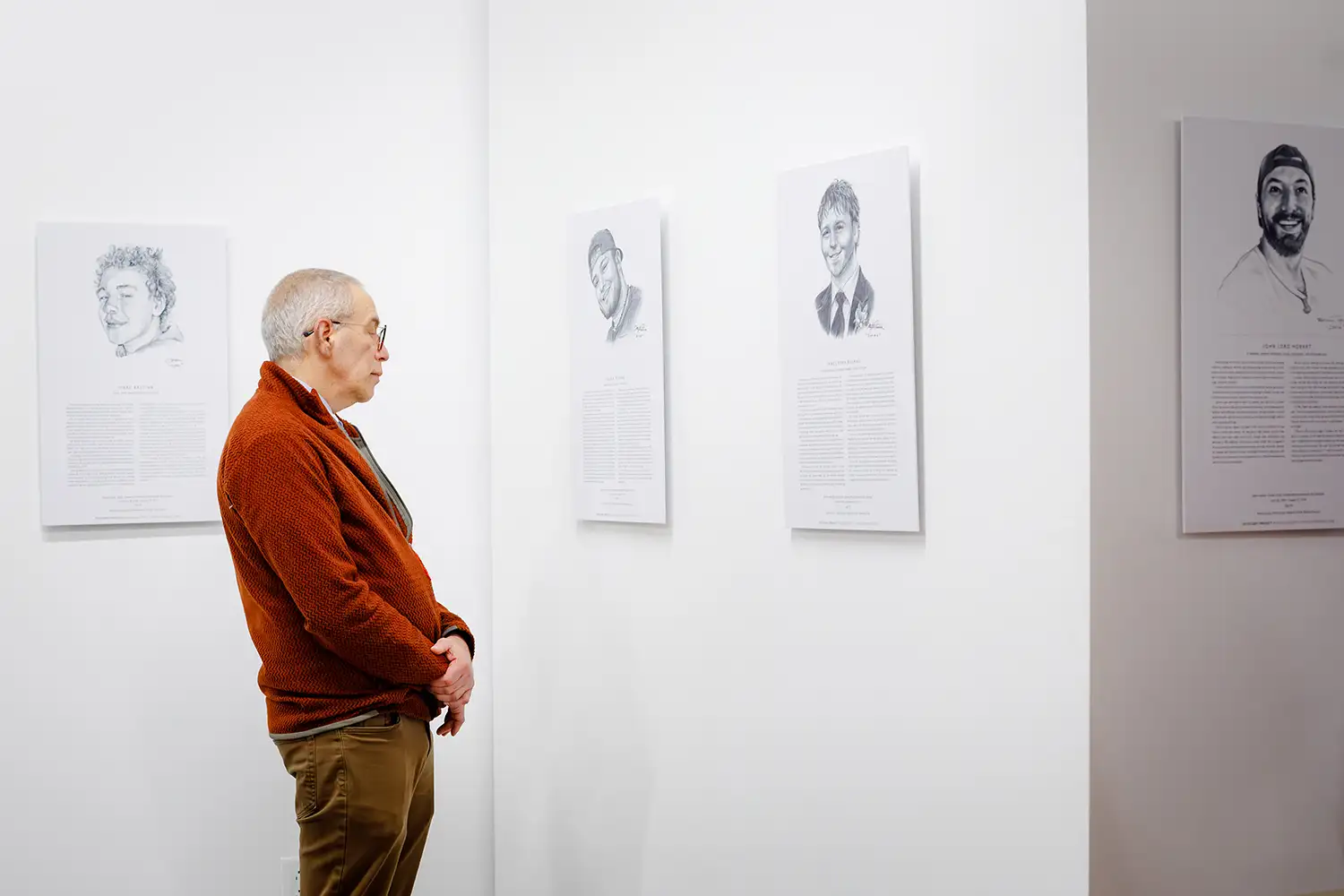
CTC has been hosted in schools, treatment centers, drug courts, government buildings, libraries, and community centers. Wherever it goes, it opens space for honest, stigma-reducing conversations about substance use disorder, recovery, and loss. It reaches people who may never visit a museum or gallery, and it keeps doing so for years after the original exhibition closes.
A Tool for Education
The Community Traveling Collection was designed to teach. Each portrait and narrative gives learners something statistics alone cannot: a real person, a real family, and a clear picture of addiction as a disease rather than a moral failing.
Schools and universities use the collection to open conversations about substance use, stigma, and person-first language. Health care providers, first responders, and drug court teams use it to reflect on how stigma shapes the care and treatment people receive. Hosts can build school visits, workshops, panel discussions, public forums, support-group gatherings, and art therapy sessions around it. The included Discussion Guide and Questions to Carry With You card help guide visitors through what they see, whether they come in a facilitated group or on their own.
The learning doesn’t end when visitors leave. Each “Ask Me About” button invites others to ask about them, and for the wearer to share one person’s story from the collection. The conversations that follow educate people about substance use disorder and helps grow a community of allies.
Built to Travel
Organizations can choose a single portrait or a curated collection of 30 or more. Each panel pairs a graphite portrait with the person’s story, professionally reproduced at 15″ x 23″ on durable luxe polymer and aluminum. The panels travel easily and hold up to repeated display, indoors or out. A collection can be a small pop-up in a classroom one week and a full installation in a public building the next.
There’s no need to wait for the original exhibition to close. Panels can be reproduced while the original is still on view, so the conversation can begin spreading right away.
Everything You Need, Ready to Use
Each collection includes:
The Impact
84% of visitors report a deeper understanding of addiction as a disease and a shift in their attitudes after engaging with the exhibition. Across states, INTO LIGHT exhibitions have reached more than 140,000 visitors, engaged over 35,000 students, and drawn extensive media coverage. Together, they have measurably reduced stigma and increased awareness of recovery resources.
Investing in the Community Traveling Collection is about more than purchasing artwork. It builds a lasting education tool that keeps the faces and stories of real people in front of the public long after the original exhibition ends. With every visitor it reaches, the collection deepens understanding of substance use disorder and builds a growing network of allies ready to support people with the disease and their families.
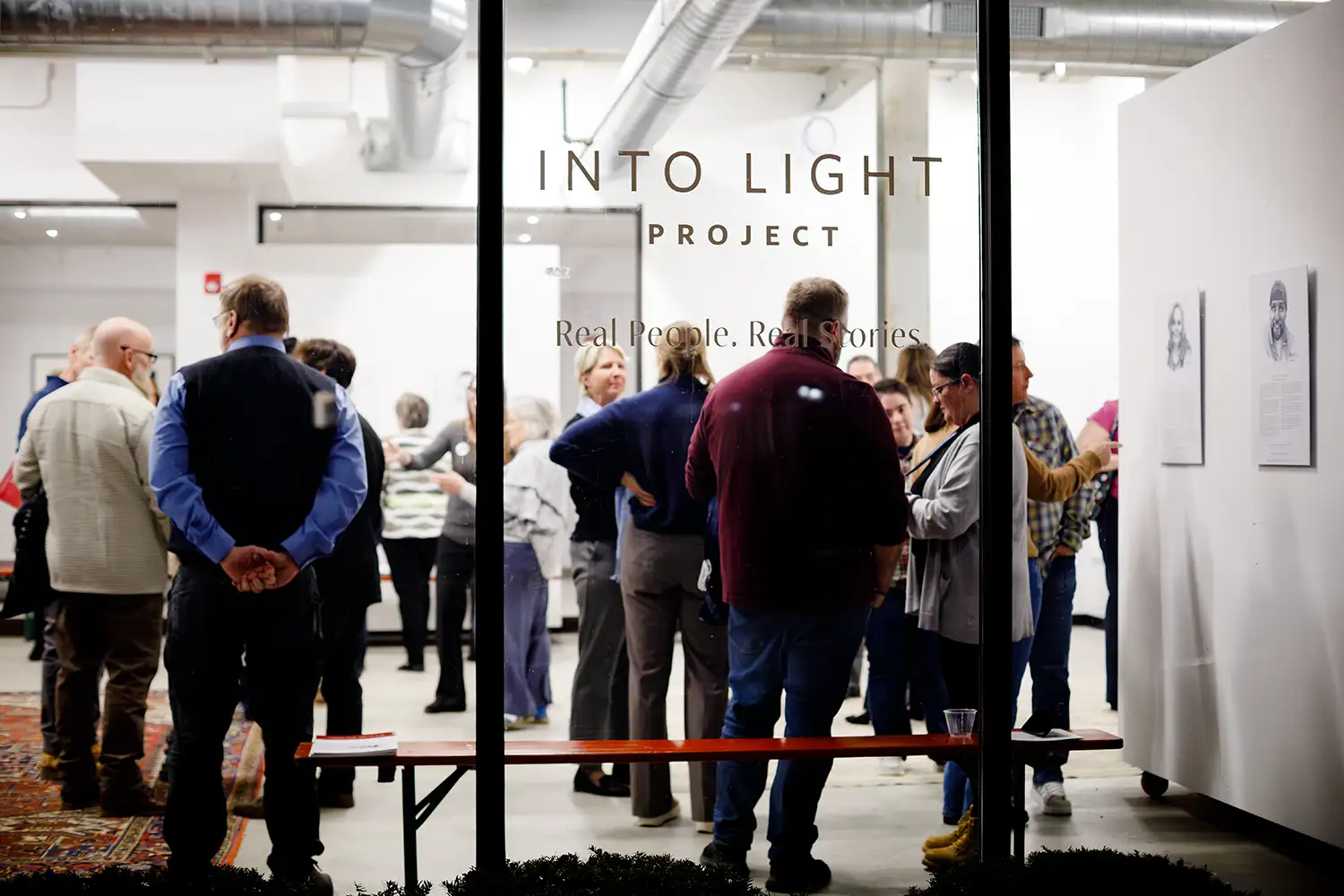
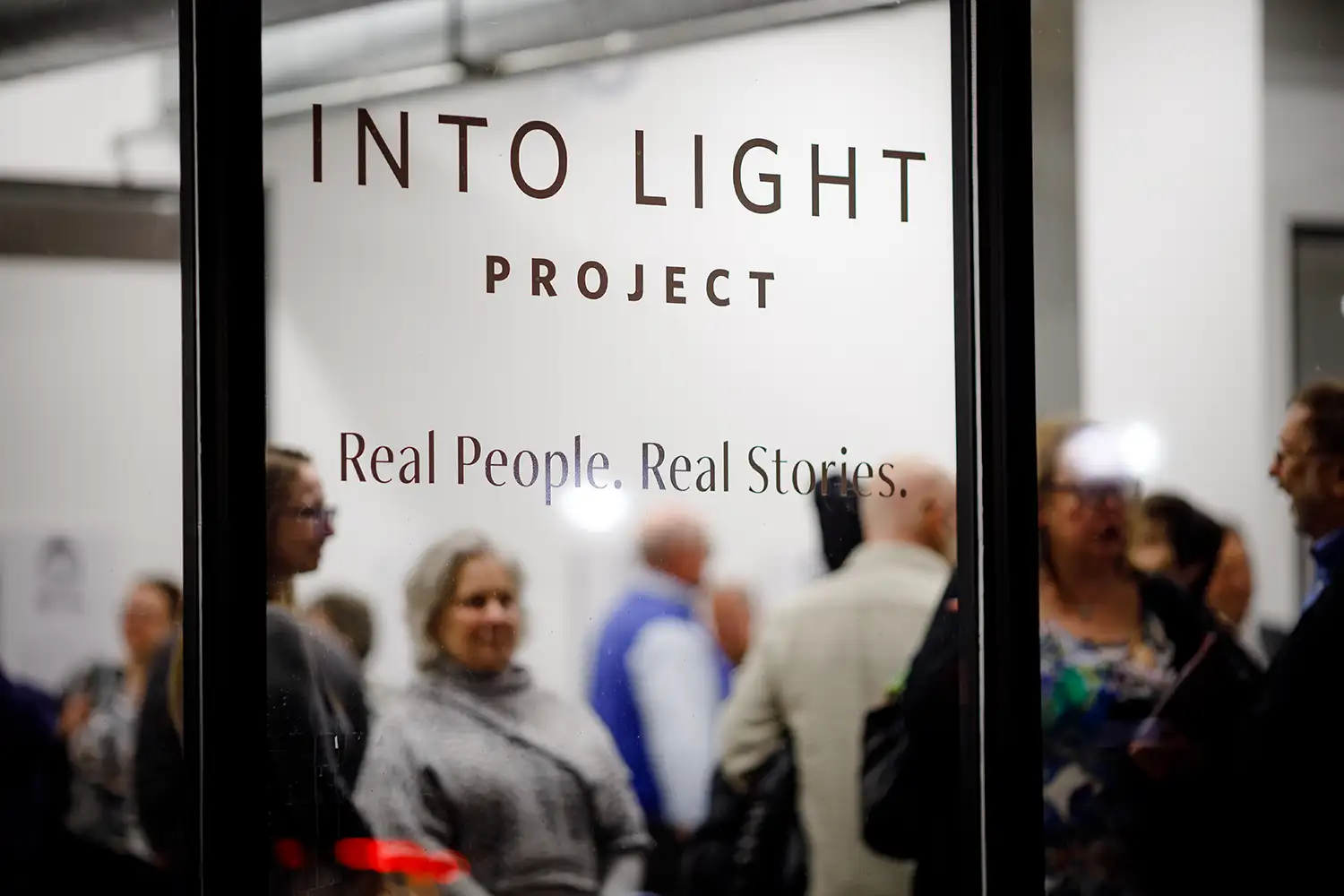
Donations support the work of the INTO LIGHT Project to produce our exhibit, Drug Addiction: Real People, Real Stories. We bring awareness to substance use disorder (SUD) as a brain disease, help to change the conversation about drug addiction, and work to erase the stigma and shame associated with it.
Support


Community Traveling Collection: bring the exhibition to every corner of your state.
The INTO LIGHT Project
We firmly believe that the internet should be available and accessible to anyone, and are committed to providing a website that is accessible to the widest possible audience, regardless of circumstance and ability.
To fulfill this, we aim to adhere as strictly as possible to the World Wide Web Consortium’s (W3C) Web Content Accessibility Guidelines 2.1 (WCAG 2.1) at the AA level. These guidelines explain how to make web content accessible to people with a wide array of disabilities. Complying with those guidelines helps us ensure that the website is accessible to all people: blind people, people with motor impairments, visual impairment, cognitive disabilities, and more.
This website utilizes various technologies that are meant to make it as accessible as possible at all times. We utilize an accessibility interface that allows persons with specific disabilities to adjust the website’s UI (user interface) and design it to their personal needs.
Additionally, the website utilizes an AI-based application that runs in the background and optimizes its accessibility level constantly. This application remediates the website’s HTML, adapts Its functionality and behavior for screen-readers used by the blind users, and for keyboard functions used by individuals with motor impairments.
If you’ve found a malfunction or have ideas for improvement, we’ll be happy to hear from you. You can reach out to the website’s operators by using the following email
Our website implements the ARIA attributes (Accessible Rich Internet Applications) technique, alongside various different behavioral changes, to ensure blind users visiting with screen-readers are able to read, comprehend, and enjoy the website’s functions. As soon as a user with a screen-reader enters your site, they immediately receive a prompt to enter the Screen-Reader Profile so they can browse and operate your site effectively. Here’s how our website covers some of the most important screen-reader requirements, alongside console screenshots of code examples:
Screen-reader optimization: we run a background process that learns the website’s components from top to bottom, to ensure ongoing compliance even when updating the website. In this process, we provide screen-readers with meaningful data using the ARIA set of attributes. For example, we provide accurate form labels; descriptions for actionable icons (social media icons, search icons, cart icons, etc.); validation guidance for form inputs; element roles such as buttons, menus, modal dialogues (popups), and others. Additionally, the background process scans all the website’s images and provides an accurate and meaningful image-object-recognition-based description as an ALT (alternate text) tag for images that are not described. It will also extract texts that are embedded within the image, using an OCR (optical character recognition) technology. To turn on screen-reader adjustments at any time, users need only to press the Alt+1 keyboard combination. Screen-reader users also get automatic announcements to turn the Screen-reader mode on as soon as they enter the website.
These adjustments are compatible with all popular screen readers, including JAWS and NVDA.
Keyboard navigation optimization: The background process also adjusts the website’s HTML, and adds various behaviors using JavaScript code to make the website operable by the keyboard. This includes the ability to navigate the website using the Tab and Shift+Tab keys, operate dropdowns with the arrow keys, close them with Esc, trigger buttons and links using the Enter key, navigate between radio and checkbox elements using the arrow keys, and fill them in with the Spacebar or Enter key.Additionally, keyboard users will find quick-navigation and content-skip menus, available at any time by clicking Alt+1, or as the first elements of the site while navigating with the keyboard. The background process also handles triggered popups by moving the keyboard focus towards them as soon as they appear, and not allow the focus drift outside it.
Users can also use shortcuts such as “M” (menus), “H” (headings), “F” (forms), “B” (buttons), and “G” (graphics) to jump to specific elements.
We aim to support the widest array of browsers and assistive technologies as possible, so our users can choose the best fitting tools for them, with as few limitations as possible. Therefore, we have worked very hard to be able to support all major systems that comprise over 95% of the user market share including Google Chrome, Mozilla Firefox, Apple Safari, Opera and Microsoft Edge, JAWS and NVDA (screen readers).
Despite our very best efforts to allow anybody to adjust the website to their needs. There may still be pages or sections that are not fully accessible, are in the process of becoming accessible, or are lacking an adequate technological solution to make them accessible. Still, we are continually improving our accessibility, adding, updating and improving its options and features, and developing and adopting new technologies. All this is meant to reach the optimal level of accessibility, following technological advancements. For any assistance, please reach out to